

Key Points:
Kevin Warsh has now chaired two Federal Open Market Committee (FOMC) meetings, keeping rates on hold. He has also sharply reduced the Fed’s forward guidance.
Markets now have to interpret the Fed for themselves for the first time since the Financial Crisis, and have demanded higher risk premiums as a result.
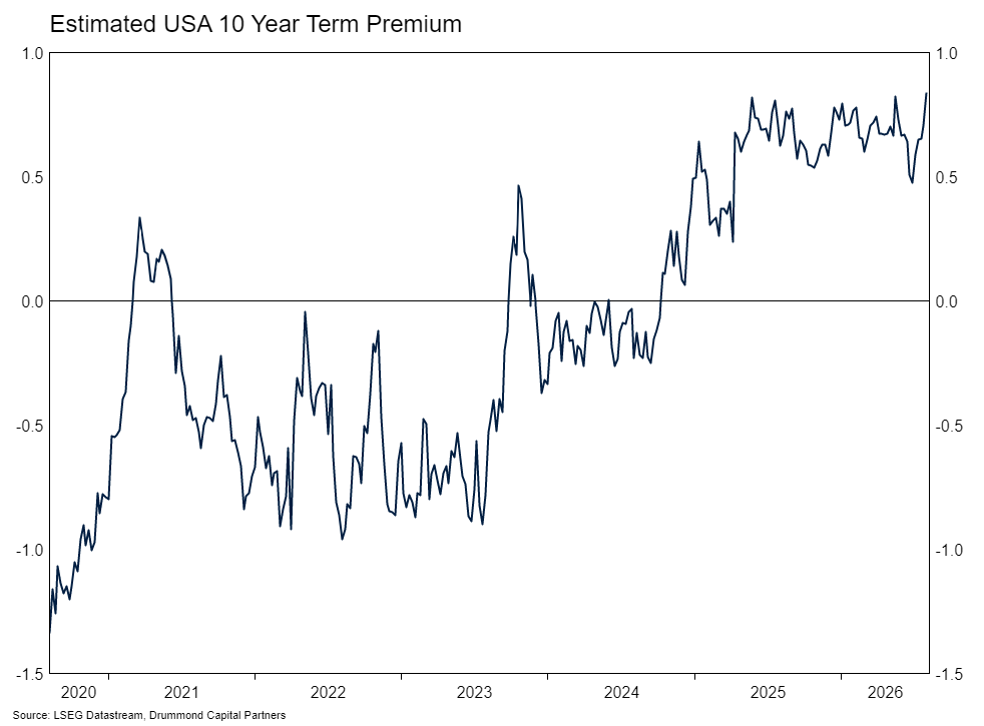
The result has been a steeper curve and a rising term premium, with the 30-year yield reaching its highest level in around two decades.
There is a case for caution in holding long-dated government bonds. The Fed’s communication shift is not the solitary reason, but it adds to sticky inflation, high deficits and an elevated political risk premium as reasons not to lend to government.
The Chair of the US Federal Reserve (Fed) is arguably the most important person to global financial markets. They set the tone for US and, to a large extent, global interest rates. Although decisions are made by committee, the Chair has a dominant role, including through the staff forecasts that help shape the Fed’s view on inflation and other key economic variables. Other Fed officials speak publicly, but the Chair carries the clearest signal of the room.
So, what happens when that signal becomes harder to read? Kevin Warsh’s first two FOMC meetings suggest he is less willing than his predecessors to provide forward guidance. Markets are now being asked to interpret the Fed with less support than they have had since the Financial Crisis. In this month’s Market Insight, we look at how markets have responded so far, and what it could mean from here.
The Song Remains the Same
Kevin Warsh has now chaired two FOMC meetings, and both ended with rates on hold at 3.50-3.75%. In June, the committee was unanimous in holding rates steady. The median participant forecast implied around half a 25bp hike this year, with nine of the eighteen participants projecting higher rates (six of them by 50bp or more), but Warsh conspicuously declined to submit his own projection. This marked the beginning of a planned reduction in forward guidance – effectively the Fed communicating to markets what it thinks will happen in the next few years. At the July meeting, while rates were again left on hold, there was significant dissent in the committee, with three members calling for a rate hike. Warsh himself, notably, voted with the majority to hold, only six weeks after markets had read him as firmly hawkish (in favour of rate rises). Warsh’s message throughout has been a flat commitment that the Fed “will deliver price stability”, without any indication of how or when.
The contrast between the two meetings shows what removing guidance can cost. June was read as hawkish, and rates rose across the curve. In July, a near-identical statement with inconsistent messaging was read as dovish, causing near-term rates to fall while breakeven inflation and long-term bond yields rose. Both meetings also produced equity selloffs despite no change in policy.
Additionally, five task forces have been set up by Warsh, with one including the Fed’s inflation framework. In July, Warsh said that while PCE inflation is the Fed’s stated target, he looks at a broad set of data to ascertain if that objective will be achieved. He also indicated that while PCE is the targeted inflation index now, the task force on that topic may recommend changing that, and that change could happen in next January’s Statement on Longer-Run Goals and Strategy. The market interpreted this as a dovish signal.
This uncertainty comes alongside a general rise in the estimated US 10-year bond term premium (the excess return investors demand to hold long-term bonds versus short-term bonds due to inflation risk and general uncertainty).
“There is no soft inflation target, there is no soft implicit target, not on this Committee’s watch. There is only a target, and it is 2 per cent.”
Communication Breakdown
The removal of forward guidance means the Fed has almost travelled full circle in its communication strategy. Around the time of the Financial Crisis, then Chair Ben Bernanke argued that greater transparency could help monetary policy flow through to the economy. A key part of that approach was telling markets that interest rates would stay near zero for many years while the economy recovered. In 2011, the Fed began holding press conferences, and in 2012 it started publishing its “Dot Plot”, showing where policymakers expected interest rates to move over the next few years.
Since then, things have moved the other way. Powell’s later years were an explicit walk-back to data dependence with repeated warnings not to read the dots as a plan, and the 2025 framework review scrapped flexible average inflation targeting (overshooting following undershoots) for flexible inflation targeting while adding a pledge to act forcefully on expectations. Warsh has continued that trend by offering no guidance, terse statements, no chair dot, and a task force to rethink communication outright.
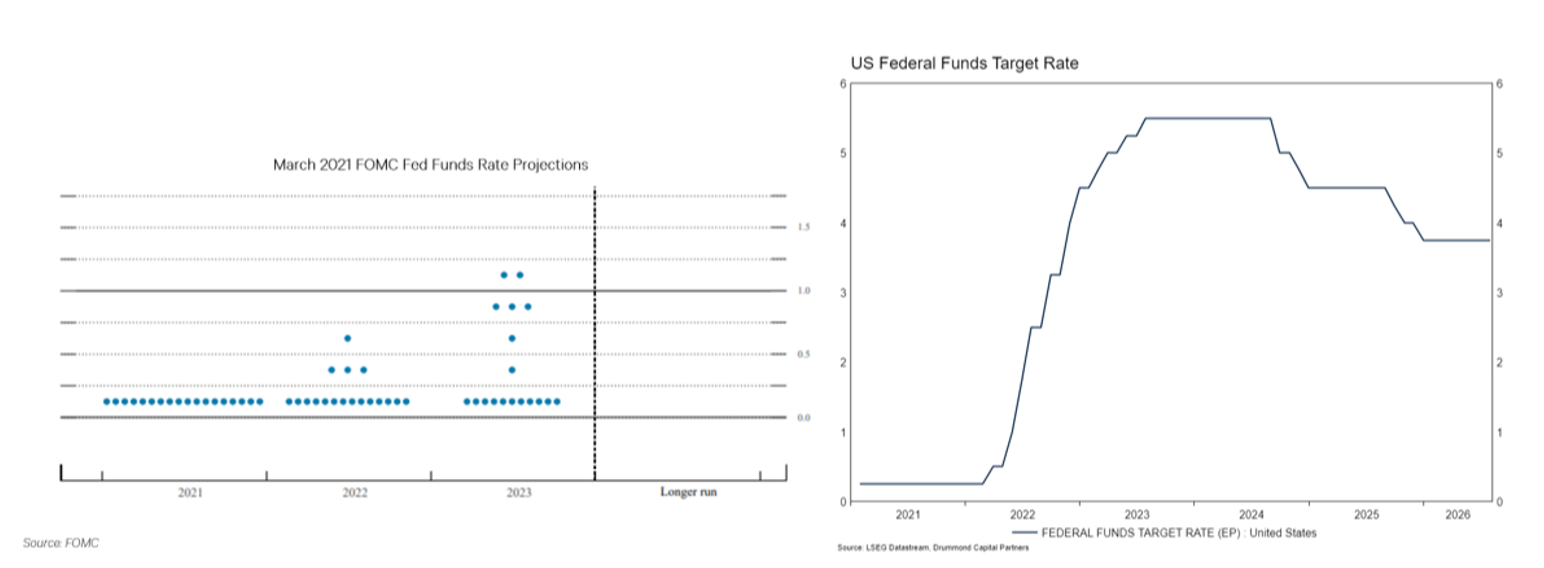
Perhaps this is the correct strategy. Forward guidance, stating rates will be around zero indefinitely, makes sense when a central bank is stuck at the zero lower bound and desperately trying to stimulate growth with few options. Now, with deflation no longer a problem, it makes sense to leave the Fed’s options open and allow the market to do some of the work for them. Indeed, Warsh noted in the last meeting that the rise in real interest rates, likely due to the lack of communication, has effectively tightened policy a little, lowering the Fed’s need to hike rates in response to still sticky inflation. Aside from that, in an uncertain world, long-term forecasts for inflation and interest rates are basically meaningless. The FOMC’s late 2021 forecasts for interest rates were for rates to stay around zero through 2023, which was clearly incorrect (see below).
The gap between rhetoric and action is the other source of discomfort. Warsh talks tough on inflation: “there is no soft inflation target, there is no soft implicit target, not on this Committee’s watch. There is only a target, and it is 2 per cent,” while simultaneously voting to hold against three dissents and indicating that the target will be assessed against an undefined broader set of measures.
In Through the Out Door
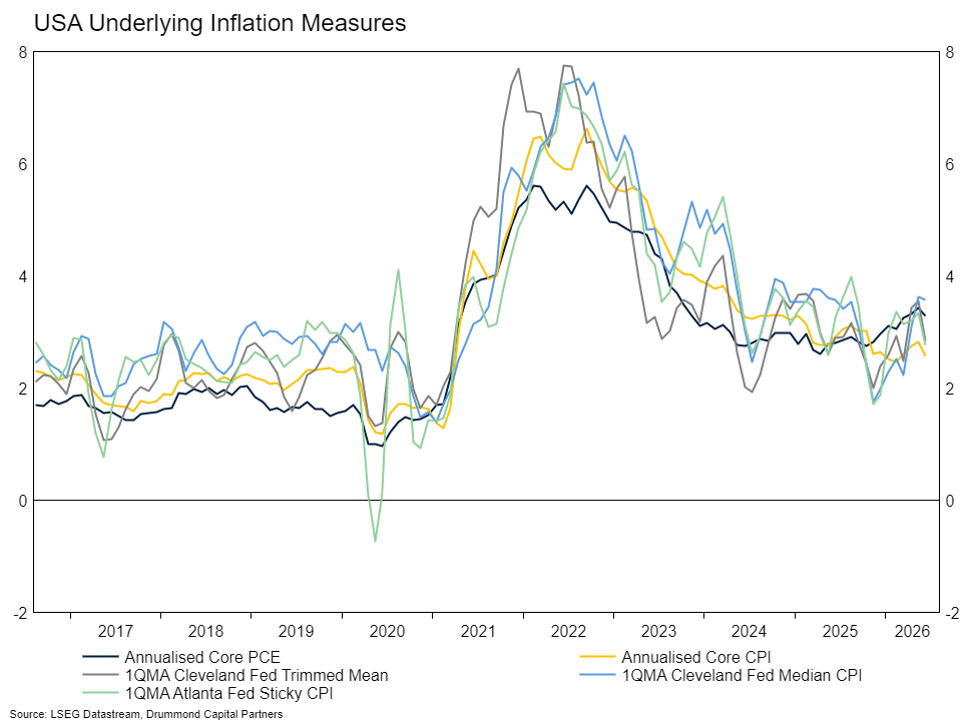
So where does that leave markets from here? Investors can no longer rely as heavily on Fed guidance when forming a view on future US interest rates. It does look like core inflation in the US has accelerated a little in recent months, following a period of stabilisation a bit above target. That feels sticky by anyone’s definition. The dark blue line in the chart below is the Fed’s current preferred measure, and it’s plain to see why Warsh was seen as dovish when he referred to other measures – they are all currently lower. Core PCE has flipped from being reliably the lowest of the major inflation measures to the highest. Core PCE has a higher weighting to software and portfolio management fees. The latter are typically charged as a percentage of assets and so rise with market returns. Software is being pushed higher by the AI capex boom.
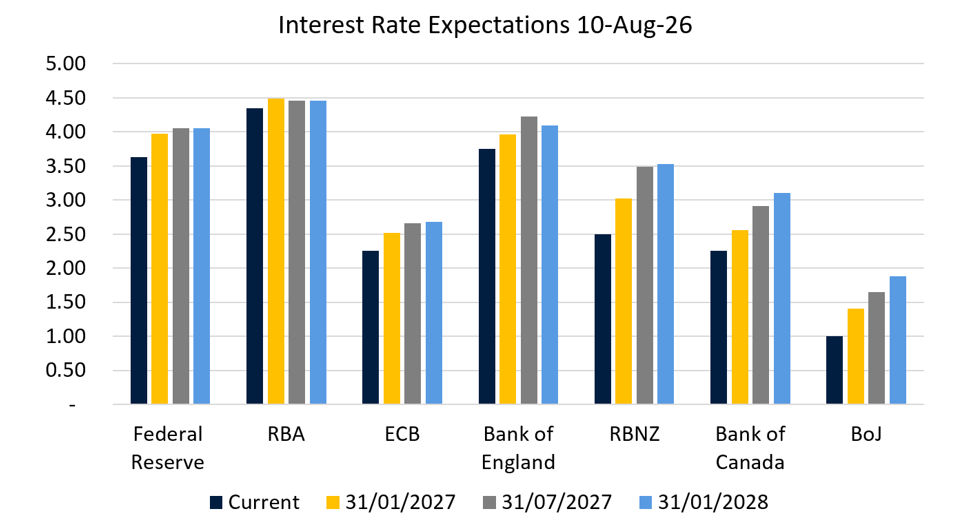
With economic growth in the US still solid, likely boosted by tariff refunds, it’s not hard to see why futures markets are pricing 1-2 rate hikes again in the US (see below). If this occurs, it would see the US join a number of other central banks, including the RBA and ECB, in a hiking cycle. The new communication regime has led to a wider than normal dispersion of Fed forecasts by economists. Some expect multiple hikes in the next 12 months, some expect multiple cuts.
Portfolio Positioning
For investors, the key point is that the case for caution around longer-dated government bonds remains intact. The shift in the Fed’s communication strategy is not the main reason for this, although it adds to the case at the margin. Inflation remains sticky across a number of economies, while government deficits and debt levels remain uncomfortably high. Fiscal consolidation appears unlikely in many developed markets, which keeps the political risk premium elevated.
In our view, investors are likely to continue demanding greater compensation to lend to governments for longer periods, particularly as significant bond supply continues to come to market. There is also a Fed-specific political risk premium worth noting. Warsh was confirmed by the narrowest margin since Senate approval was first required in 1977 and was asked at his confirmation hearing whether he would be a “sock puppet” for the President, to which he answered “absolutely not”. In early August, it was reported that the President had periodically telephoned him to ask about his forecasts and opinions. Nothing improper has been alleged. However, a central bank that has reduced its explanation of its reaction function, while its independence is being tested, is one investors may reasonably demand more compensation to lend against.
Disclaimer:
Prepared in conjunction with our external investment consultants Drummond Capital Partners (Drummond) ABN 15 622 660 182, AFSL 534213. It is exclusively for use for Opus Wealth clients and should not be relied on for any other person. Any advice or information contained in this report is limited to General Advice only.
The information, opinions, estimates and forecasts contained are current at the time of this document and are subject to change without prior notification. This information is not considered a recommendation to purchase, sell or hold any financial product. The information in this document does not take into account any of your objectives, financial situation or needs. Before acting on this information recipients should consider whether it is appropriate to their situation. We recommend obtaining personal financial, legal and taxation advice before making any financial investment decision. To the extent permitted by law, Opus Wealth Pty Ltd makes no warranties or representations about the accuracy or completeness of the content of this publication and excludes any liability which may arise as a result of the use of the content of this publication. Past performance is not a reliable indicator of future performance.
This report is based on information obtained from sources believed to be reliable, we do not make any representation or warranty that it is accurate, complete or up to date. Any opinions contained herein are reasonably held at the time of completion and are subject to change without notice.